
Information Technology and Informatics Students Step Inside Verizon’s Global Network
During this class trip to Verizon, IT & Informatics students gained insight into the collaborative nature of large-scale network operations and the human decision-making behind automated systems. From the user's perspective, the internet can seem to work effortlessly. Messages send instantly, videos stream without pause, and connections rarely fail. But behind that seamless user experience is a vast and immensely complicated global communications network that never sleeps.
For students in the SC&I Information Technology and Informatics course Network and Internet Technology, taught by Associate Teaching Professor of Library and Information Science Jon Oliver, that network, invisible to most of us, came sharply into focus during a class trip they took to Verizon’s Executive Briefing Center and Emergency Operations Center in Basking Ridge, New Jersey.
The visit pulled students out of the classroom and into the nerve center of one of the world’s largest telecommunications companies, where global connectivity is tracked, tested, and protected in real-time.
Oliver said that kind of firsthand exposure is exactly the point. 'I have always provided some experiential opportunities for students to speak with outside professionals and tour network facilities. It’s important for students to see how what we talk about in class actually works in the real world.'
Oliver has taught multiple sections of the Network and Internet Technology course for years and has long built opportunities for industry engagement into the curriculum. Before the pandemic, he partnered with AT&T to bring students into its Global Network Operations Center, a facility that once handled roughly one-third of all global network traffic. When that opportunity ended, Oliver searched for a new way to deliver a comparable experience.
“This year I was able to make contact with Verizon executives, and they agreed to host my students at the Verizon Executive Briefing Center and Emergency Operations Center,” Oliver said. Turning that invitation into a reality required coordination and funding. Oliver submitted a grant proposal to cover transportation costs and, once approved, arranged for a chartered bus so students could attend without added financial stress.
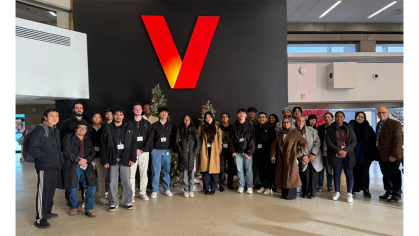
About 25 students ultimately made the trip, and from the moment they arrived, the scale of Verizon’s operations was clear. Verizon executives and recruiters welcomed the group and led them through the facility, beginning with an overview of the company’s network and its role in global communications. Recruiters also spoke directly with students about internships and employment opportunities, offering insight into how academic skills translate into industry careers.
For many students, the most striking stop on the tour was the Emergency Operations Center—the command hub where Verizon monitors and controls its global network. Rows of screens display real-time data, visualizing traffic flow, performance metrics, and security alerts. In that room, academic concepts like redundancy, network resilience, and threat response moved from lecture slides to lived reality.
“Seeing the emergency operations center really changes how you understand networks,” Oliver said. “This is where they control and monitor their global network. It makes clear how much responsibility is involved and how critical these systems are.”
The tour didn’t stop at monitoring. Students were also taken into Verizon’s laboratory facilities, where new technologies are rigorously tested before deployment. Inside the labs, students encountered tools that hint at the next generation of connectivity.
'We toured their laboratory facilities where new technologies are vetted,' Oliver explained. 'Students got to see some emerging robotic and cellular and satellite technologies, which really excited them.'
That excitement was evident throughout the visit. Students asked technical questions, drew connections to recent coursework, and lingered over demonstrations that illustrated how innovation and security go hand in hand. “The students loved seeing what Verizon is doing as well as how their network is monitored and secured,” Oliver said.
Beyond the technical lessons, the trip offered something less tangible, but equally valuable. By interacting directly with Verizon professionals, students gained insight into the collaborative nature of large-scale network operations and the human decision-making behind automated systems. The experience demystified what working in telecommunications looks like day-to-day and helped students imagine themselves in similar roles.
“It was a great experiential learning experience,” Oliver said, emphasizing that moments like these often have lasting impact. “When students can connect theory to practice, it sticks with them.”
The visit also marked the start of an ongoing relationship between the IT and Informatics program and Verizon. “Verizon has agreed to host us each semester,” Oliver said, turning a single trip into a recurring opportunity for applied learning. “I plan to continue to bring my students back.”
For IT and Informatics students, the trip offered more than a tour. By stepping into the heart of Verizon’s network operations, students saw how the systems they study power everyday life on a global scale. In a field often defined by what users don’t see, the experience made the invisible visible and reinforced why learning beyond the classroom matters.


