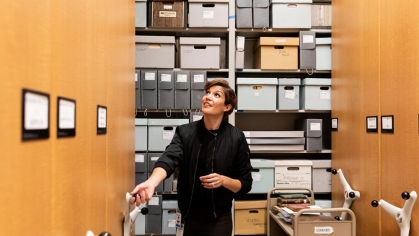
Manage, protect, and share physical and digital records, preserving them as reliable evidence and historical memory.

Concentrations
A concentration lets you develop focused expertise in areas like Library and Information Science or Data Science. The Master of Information program combines core courses with flexible options to tailor your studies to your goals. Some specialized classes may be in-person only, but online students can find equivalent alternatives with advisor guidance.
While your transcript shows your academic path, employers value your portfolio and practical experience most. The program director can help you choose a concentration that aligns with your career goals and ensure you build the skills needed to succeed.
Choose From Among These Diverse Concentrations
Manage, protect, and share physical and digital records, preserving them as reliable evidence and historical memory.

Collect, analyze, and visualize data, preparing you for careers in e-commerce, finance, healthcare, and research.

Connect diverse audiences with reliable health resources through courses in information behavior, health informatics, and more.

Design, improve, and implement technology that enhances user experiences through practical and theoretical expertise.

Combine theory and practice to provide information services, support communities, and lead in the field.

Prepares students to lead, teach, and manage information in schools, public libraries, college libraries, and beyond.

Develop leadership, data analysis, and project management skills in preparation to manage information systems and drive organizational success.

Students may also develop an individual pathway within the MI program. Students pursuing this option work with a faculty advisor to ensure the pathway is coherent and aligned with academic and professional goals while meeting general program requirements.
Professional Certifications
The Master of Information program supports several professional certifications that can enhance your credentials and expand your career opportunities. These certifications align with national and state standards and are available to students who complete required coursework and, in some cases, field experiences.
Public Library Certification
If you plan to work in a public library in New Jersey, you’ll need a Professional Librarian Certificate issued by the state. The certification process is now handled by Thomas Edison State University, on behalf of the New Jersey State Library. Once granted, this certificate is permanent—you won’t need to renew it.
School Library Media Specialist Certification
Obtaining school library certification in New Jersey can be confusing, but we’re here to help. The SC&I Office of Student Services provides comprehensive guidance on state certification requirements and how to apply. The process varies depending on your education, certifications, and professional goals.
Have Questions?
We're here to help.
Email us