Newark’s Ironbound Neighborhood Shines in MCM Students’ Social Media Strategy for the 2026 FIFA World Cup
A Master of Communication and Media class developed a social media strategy to help the Ironbound Business Improvement District (IBID) promote its historic neighborhood as an exciting soccer-culture destination during the World Cup.
As anticipation builds for the 2026 FIFA World Cup, New Jersey is stepping confidently into the global spotlight. For the very first time, the NY–NJ region will serve as a host of the tournament’s final. Eight games, including the Grand Final on July 19, 2026, will be held at the New York New Jersey Stadium (MetLife Stadium).
This exciting event will bring to the region 48 teams (including Brazil, England, and France), 104 matches, and over a million visitors. As we quickly approach the end of 2025, local communities are already beginning to gear up for the unprecedented foot traffic, economic opportunity, and global visibility the games will bring.
Though Jersey City will host an official fan zone, Newark’s Ironbound neighborhood is also vying for its share of the spotlight. To help the neighborhood attract visitors, SC&I Instructor Carlos Ferreira created a novel assignment for his Master of Communication and Media students: create a social media campaign the Ironbound Business Improvement District (IBID) can use. The objective: position the Ironbound as a must-visit soccer culture destination during the 2026 World Cup.
“A project like this gives students a chance to work with a real client and directly contribute to a meaningful challenge,” said Ferreira, who partnered with IBID Executive Director Vince Baglivo. “I want the students to feel their contribution truly matters during this historic moment for New Jersey.”
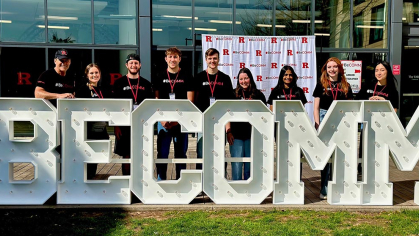
To ground their work in authentic experience, Ferreira brought the class to the Ironbound for dinner, pastries, and a firsthand look at the neighborhood’s culture. That visit became the foundation of their strategy.
Capturing 50,000 Visitors Through Authenticity

The students set an ambitious, data-driven goal. “By July 21 2026, our goal is to increase Ironbound visitor traffic by 20% compared to summer 2025, and bring at least 50,000 visitors during the World Cup,” said student Longyu Zhang MCM’26. “If Ironbound can capture even 5% of the 1.2 million anticipated visitors to the region, we can achieve our goal.”
To help develop their plan, they analyzed the competing NJ destinations — Liberty State Park, Hoboken, Jersey City, and New York City. Student Markus Inumerable MCM’26 voiced the clear opportunity: “The goal is to position the Ironbound as a more flavorful and more deeply rooted cultural experience — not just an urban stop.”
The team argued that while competing locations offer variety, they lack a cohesive identity. “Jersey City often struggles with clear identity,” they explained. “It's not as iconically tied to a single cultural trend as the Ironbound.”
Experiencing the Ironbound — and Turning It Into Strategy
A class trip revealed the neighborhood’s unique spirit. “We watched this amazing performance by this guy playing Spanish Flamenco,” Inumerable recalled. “Honestly… I felt like I was in Spain.” That moment shaped the tone of their content. “If we marketed the Ironbound as a place where international experiences can happen in the U.S., it would be very welcoming—especially for people wanting a glimpse of home.”
Inumerable also identified a key logistical advantage. “Many international visitors may not realize that MetLife Stadium is in New Jersey … but that challenge becomes our strategy. We want to promote the Ironbound as the closest international soccer neighborhood to the stadium.”
#TasteTheGame: Connecting Food and Football
Student Yuran Zhou MCM’27 led development of the signature campaign hashtag, #TasteTheGame. “It will connect football emotion with Ironbound’s food cultures,” she explained. “Food is a strong part of Portuguese and Brazilian identity, so it becomes a natural way to tell our stories.”
She proposed restaurant partnerships, match-day menus, cultural group collaborations, and even interactive wall art with local artists and musicians. The team also visited SPT TV in the Ironbound, exploring additional media amplification.
To unify content for global visitors, the team proposed using #Ironbound as a consistent, language-free navigation tool.
Humanizing the Ironbound
For student Elvis Maravillas MCM’27, storytelling was the heart of the campaign. “The content plan is to humanize the Ironbound — to portray it as a warm, authentic, welcoming place and position it as the true hometown district of the World Cup,” he explained.
Inspired by how nearby Elizabeth residents personify their city by referring to it with the pronoun “she,” Maravillas suggested giving the Ironbound its own persona — “like a brother or sister you’re visiting.”
That idea shaped content such as fashion reels (“soccer fans are famous for wearing insane getups”), nightlife clips, emotional game reactions, small-business spotlights, and celebrations of the neighborhood’s tight-knit community.

Measuring Real Impact
For student Haiji Xiao MCM’26, using analytics were essential. “Our strategy is only meaningful if we can show clear, measurable outcomes,” Xiao said.
These measurements included:
- Social impressions and reach
- Engagement metrics: saves, shares, comments, stories
- Website click-throughs on restaurant maps and guides
- Foot-traffic data from partnering restaurants
- Watch-party attendance
- Increases in Google and Yelp reviews
- User-generated content using #Ironbound and #TasteTheGame
“These measures allow us to see if our campaign is not only inspiring interest, but actually driving people into the neighborhood,” Xiao explained.
A Client’s Perspective: “Real Deal Stuff”
When students presented their campaign, IBID Executive Director Vince Baglivo offered enthusiastic praise. “Taste the Game is really great stuff… that’s engagement,” he told them. “Your analysis of the areas of competition is spot on.”
Baglivo emphasized that authenticity is the Ironbound’s greatest strength. “We offer real deal stuff — the food, the music, the culture. Everything is real. It’s not made up.”
He also appreciated the team’s focus on analytics. “Somebody’s going to pay for all of this… they want to know what we get for our money. The social media data you focused on is smart and measurable.”
In the end, Baglivo summed up his reaction by simply saying, “I’m blown away.”
Learn more about the Master of Communication and Media degree on the Rutgers School of Communication and Information website.
Photo credit: Carlos Ferreira